Smart Automotive Manufacturing Process Evolution
Smart Automotive Manufacturing Process
The Smart Automotive Manufacturing Process Evolution defines the shift from linear vehicle assembly toward fully digitized, sensor driven, and software coordinated production ecosystems where design, validation, fabrication, and logistics operate as an integrated computational system rather than a sequence of isolated industrial steps.
Digital Thread Integration Across Production
Modern vehicle manufacturing depends on the digital thread, a continuous data architecture linking concept modeling, engineering validation, plant execution, and lifecycle feedback. Engineering files no longer terminate at design approval. They propagate directly into manufacturing execution systems, robotics programming, and quality analytics.
Product lifecycle management platforms synchronize design revisions with factory instructions, eliminating translation errors that once required manual recalibration. Research published by the Society of Manufacturing Engineers shows that digital continuity reduces launch defects by enabling simulation validated production before physical tooling begins.
Digital twins replicate entire factories within simulation environments, allowing manufacturers to test throughput, ergonomics, and maintenance scenarios before equipment installation. Industrial automation providers such as ABB Robotics deploy virtual commissioning tools that validate robot paths and cycle times in software, compressing plant startup timelines.
This architecture transforms manufacturing from reactive correction to predictive orchestration.
Smart Automotive Manufacturing Process Evolution
Production facilities now function as adaptive systems capable of real time self optimization. Sensors embedded across stamping presses, paint booths, and assembly cells continuously stream operational data into analytics engines that detect variance before it becomes defect.
Traditional statistical sampling is replaced by full population monitoring. Machine vision inspects every weld, torque tool, and surface finish. AI models correlate anomalies with upstream variables such as material batch composition or environmental conditions.
Standards frameworks from the International Organization for Standardization guide interoperability between equipment, ensuring machines from multiple vendors communicate through unified industrial protocols. Without these standards, digitization would fragment into incompatible silos.
The result is a production environment that behaves more like a distributed software platform than a mechanical factory.
Advanced Robotics and Human Machine Collaboration

Industrial robotics no longer operate inside isolated cages performing repetitive welds. Collaborative robots work alongside technicians, handling precision tasks while humans supervise adaptive decision making. These systems incorporate force sensing, spatial awareness, and learning algorithms that allow rapid reconfiguration for new vehicle models.
Automakers deploy flexible robotic cells capable of assembling multiple platforms without major hardware replacement. This flexibility supports shorter product cycles driven by electrification and software updates.
According to analysis by McKinsey Automotive and Assembly, flexible automation can reduce changeover costs dramatically, allowing plants to switch production mixes in response to demand volatility rather than maintaining single model lines.
Human roles evolve toward diagnostics, programming, and systems integration. Workforce capability shifts from mechanical repetition to technical orchestration.
Materials Engineering and Lightweight Fabrication
Manufacturing transformation includes radical material diversification. High strength steel, aluminum alloys, carbon composites, and engineered polymers coexist within single vehicle architectures, requiring new joining technologies and thermal management strategies.
Laser welding, friction stir welding, and structural adhesives replace conventional spot welds to accommodate mixed materials without compromising rigidity. Technical resources from the American Welding Society document how hybrid joining processes enable lightweight structures necessary for electrified powertrains.
Additive manufacturing introduces localized fabrication of complex geometries that cannot be stamped or cast. Components such as cooling channels, sensor housings, and customized brackets are produced layer by layer, reducing tooling dependency and shortening development cycles.
Material traceability systems track each batch from supplier to installation, ensuring compliance with safety and sustainability requirements.
Electrification Driven Production Redesign
Electric vehicles impose fundamentally different manufacturing constraints compared to combustion platforms. Battery pack integration, thermal shielding, and high voltage routing require new assembly logic and safety protocols.
Battery module assembly resembles electronics manufacturing more than traditional engine production. Clean environments, precision stacking, and automated inspection dominate the process. Guidance from the International Energy Agency emphasizes that battery manufacturing scale determines the economic viability of electrified transportation.
Gigafactory models centralize cell production near vehicle plants to reduce logistics cost and maintain quality control. These facilities rely heavily on automation to maintain consistency across millions of individual cells.
Thermal management validation, electrical isolation testing, and software calibration become core stages of vehicle completion, displacing legacy engine calibration lines.
Data Centric Quality Assurance
Quality assurance transitions from end of line inspection to continuous validation embedded within each manufacturing stage. Sensors verify torque application, dimensional tolerances, and software configuration as operations occur.
Manufacturers deploy edge computing nodes directly on factory floors to process inspection data without latency. Defects trigger automatic containment workflows, isolating affected components before they propagate downstream.
Organizations such as the National Institute of Standards and Technology promote smart manufacturing frameworks where measurement science integrates with automation to create traceable, repeatable production intelligence.
Predictive maintenance uses vibration analysis, thermal imaging, and acoustic monitoring to detect equipment wear long before failure, preventing costly downtime.
Supply Chain Synchronization and Transparency
Automotive manufacturing historically relied on deeply tiered supply networks with limited visibility beyond direct suppliers. Digitalization introduces end to end transparency, connecting raw material extraction to final assembly through shared data platforms.
Blockchain based traceability systems authenticate origin, compliance, and movement of critical materials such as lithium and semiconductor substrates. This visibility mitigates disruption risk and ensures regulatory adherence.
Logistics optimization tools analyze global shipping flows, dynamically adjusting sourcing routes. The World Economic Forum highlights that resilient supply ecosystems depend on shared intelligence rather than isolated procurement strategies.
Suppliers integrate directly into production planning systems, enabling synchronized manufacturing schedules rather than forecast driven ordering.
Sustainable Manufacturing Imperatives
Environmental performance now shapes factory design as strongly as productivity metrics. Plants incorporate renewable energy sourcing, closed loop water systems, and waste heat recovery to minimize lifecycle emissions.
Lifecycle analysis tools quantify carbon intensity across each manufacturing step, guiding process selection and supplier qualification. Programs described by the United Nations Industrial Development Organization emphasize resource efficient production as a prerequisite for long term industrial competitiveness.
Recycling infrastructure captures scrap metals, polymers, and battery materials for reintegration into production, forming circular supply loops that reduce dependence on virgin extraction.
Sustainability becomes embedded engineering logic rather than external compliance reporting.
Software Defined Production Systems
Vehicles increasingly depend on software functionality, and manufacturing must ensure that digital configuration aligns precisely with hardware installation. Assembly lines now include software flashing stations, cybersecurity validation, and connectivity testing.
Over the air update capability requires secure provisioning during manufacturing to prevent vulnerabilities later in the vehicle lifecycle. Cybersecurity guidelines from the UNECE World Forum for Harmonization of Vehicle Regulations mandate traceable software management throughout production and operation.
Manufacturing execution systems track not only physical components but also firmware versions, encryption keys, and feature activations installed during assembly.
Production output becomes both a mechanical product and a validated digital environment.
Flexible Platform Manufacturing
Global manufacturers reduce complexity by designing modular architectures capable of supporting multiple vehicle types. A single platform may underpin sedans, crossovers, and commercial variants with minimal structural change.
Flexible body shops use programmable tooling and adaptive fixturing to accommodate dimensional variation without rebuilding lines. This modularity spreads development investment across higher volumes, stabilizing financial returns.
Lean production methodologies evolve into intelligent flow systems where scheduling algorithms dynamically balance workload across stations. The Lean Enterprise Institute documents how digital lean integrates analytics with traditional waste reduction principles.
Factories thus achieve both scale efficiency and customization capability.
Autonomous Inspection and AI Assisted Decision Making
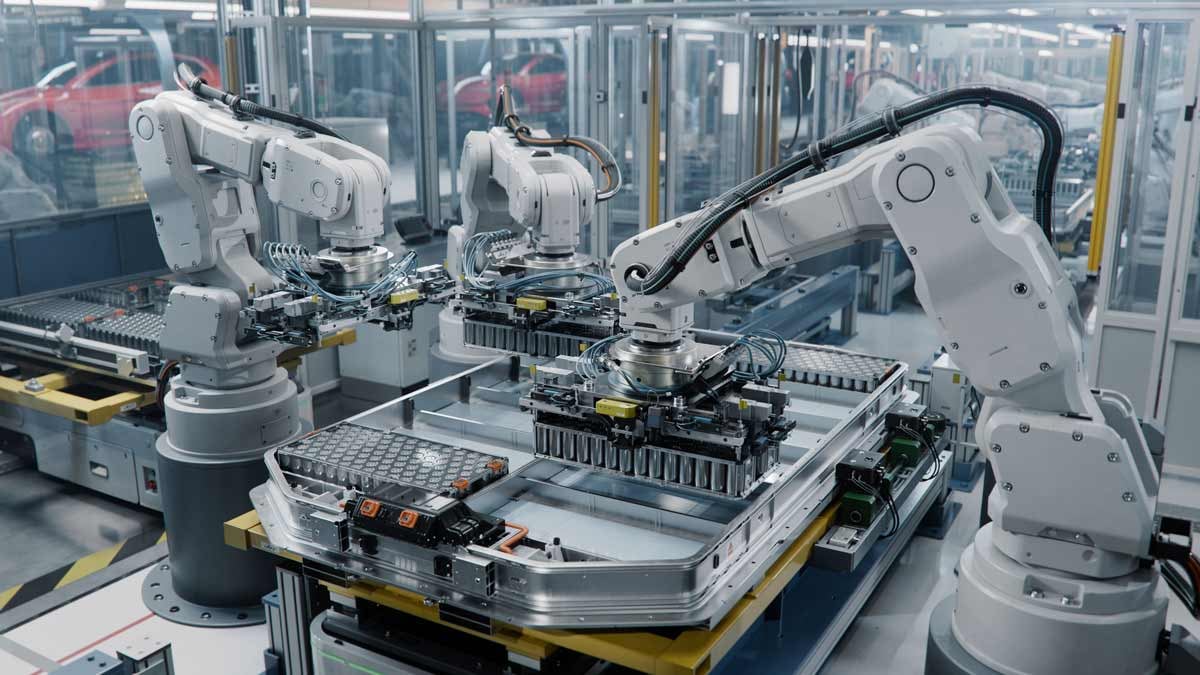
Artificial intelligence extends beyond analytics into autonomous operational control. Machine learning models analyze production conditions and automatically adjust parameters such as weld current, paint viscosity, or curing temperature.
Computer vision systems detect microscopic irregularities invisible to human inspectors, ensuring consistent quality at industrial speed. These systems continuously retrain using production data, improving accuracy over time.
AI supported scheduling forecasts bottlenecks and reallocates resources preemptively, maintaining throughput stability even during supply variation.
Manufacturing intelligence becomes iterative rather than static.
Global Standardization and Interoperability
As automotive production globalizes, interoperability between facilities becomes essential. Common data structures, communication protocols, and safety frameworks allow plants across continents to replicate processes with minimal localization.
Industrial communication standards such as OPC Unified Architecture enable machines, sensors, and enterprise software to exchange information seamlessly across vendors and geographies. Technical documentation from the OPC Foundation defines these interoperability layers.
Standardization reduces redundancy, allowing engineering updates deployed in one region to propagate instantly worldwide.
Workforce Transformation and Skill Recomposition
Manufacturing personnel transition from manual assembly toward high skill technical supervision. Training focuses on robotics calibration, data interpretation, and system diagnostics.
Educational institutions collaborate with manufacturers to build interdisciplinary curricula combining mechanical engineering, software development, and industrial analytics. Programs highlighted by MIT Leaders for Global Operations demonstrate how cross functional expertise supports modern production environments.
Human contribution concentrates on oversight, innovation, and exception handling while machines execute repeatable tasks.
Resilient Manufacturing Architecture
Geopolitical shifts, semiconductor shortages, and logistics disruptions reveal structural fragility in tightly optimized production networks, compelling manufacturers to embed the Smart Automotive Manufacturing Process into factory redesign through localized sourcing, modular capacity scaling, and digitally synchronized operations.
Microfactories and regional assembly hubs, structured around the Smart Automotive Manufacturing Process, reduce dependence on single large scale plants and enable distributed production calibrated to regional demand, resembling cloud computing architecture that emphasizes redundancy and scalable deployment.
Within this framework, the Smart Automotive Manufacturing Process elevates resilience to a core engineering parameter alongside cost efficiency and production velocity.
Continuous Manufacturing Intelligence
Automotive production advances into continuous optimization through the Smart Automotive Manufacturing Process, where operational data is routed back into engineering systems to accelerate refinement of components, workflows, and performance parameters. Active vehicles generate real world intelligence that directly shapes subsequent manufacturing calibration.
This Smart Automotive Manufacturing Process establishes a closed loop structure that removes the separation between fabrication and lifecycle management, driving constant evolution instead of intermittent modernization cycles.
Industrial change is therefore not a discrete technological upgrade but the Smart Automotive Manufacturing Process acting as a systemic reconfiguration of how mobility products are designed, built, verified, and progressively enhanced over time.